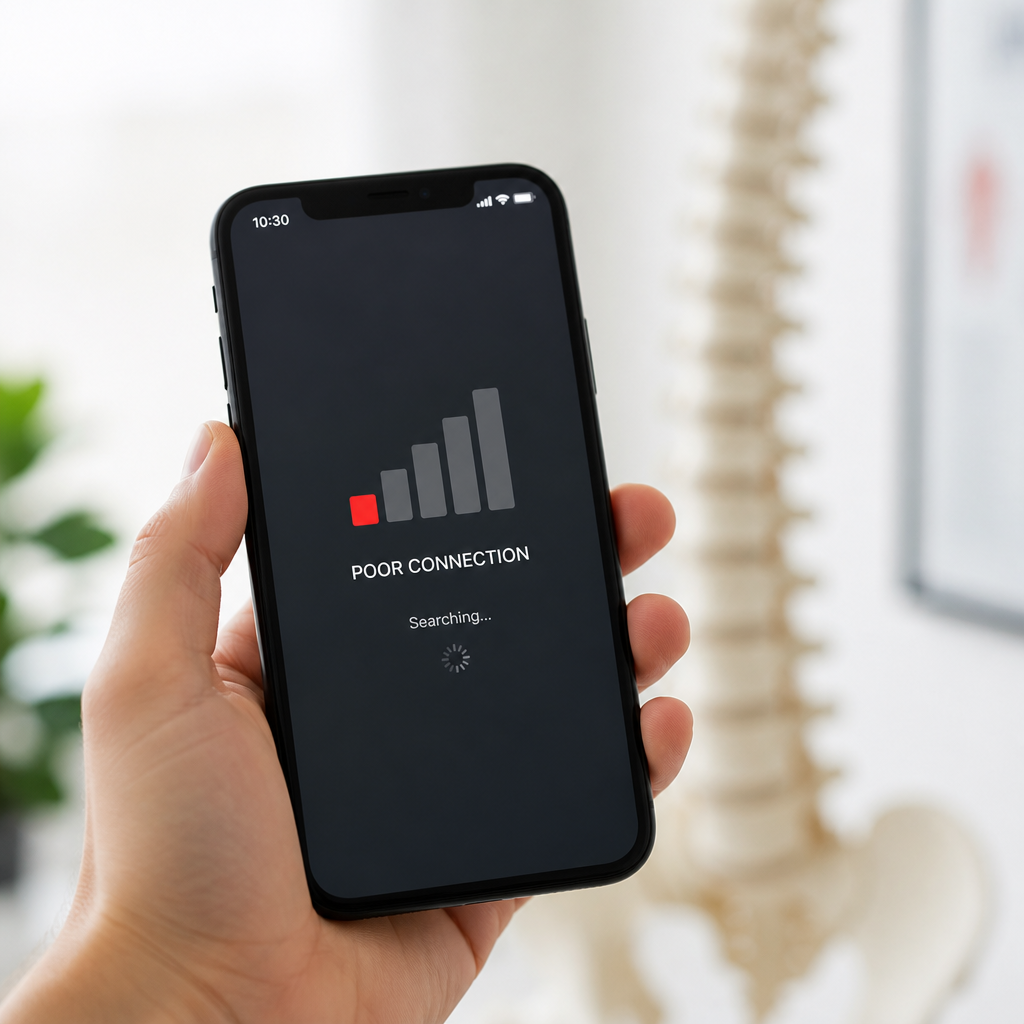
Remember that old commercial? The guy walking around, phone pressed to his ear, asking over and over: "Can you hear me now?"
It was funny because everyone's been there. You're standing in the middle of nowhere, holding your phone up in the air like a prize, spinning in circles, trying to find the one spot where the signal breaks through.
Sometimes it works. Sometimes it doesn't. And when it doesn't, every call gets dropped, every text gets garbled, and every video buffers until you want to throw the thing out the window.
The Tower and the Phone
Your body has the same setup. Your brain is the cell tower — the broadcast center. Your spinal cord and nerves carry the signal. And every cell, tissue, and organ in your body is the phone waiting for the call.
Every second of every day, your brain is sending messages down the line. "Heart, keep beating." "Lungs, take a breath." "Stomach, digest lunch." "Immune system, stand ready."
And your body is sending messages back. "I'm tired." "I need water." "Everything's good down here."
These calls absolutely, positively have to get through. Not just when it's convenient. Not just when you remember to think about it. Every moment of your life.
The Spotty Coverage
Now, what happens when your spine has a subluxation?
A vertebral subluxation is a bone in your spine that's shifted out of place and interfering with the messages traveling between your brain and your body.
It's not a dead zone. It's more like spotty coverage.
Sometimes the message gets through just fine. Sometimes it comes through all broken up — like a call where the other person's voice keeps cutting in and out. Sometimes it drops entirely.
Not all the calls get dropped. Just enough to cause static. Just enough to slow things down. Just enough that the message doesn't arrive the way it was sent.
And here's the sneaky part: you probably don't feel it.
You Don't Know What You're Missing
Your phone tells you when it has bad signal. It shows those little bars right there on the screen. You know exactly when you're in a dead zone.
Your body doesn't do that.
Most of your nervous system isn't wired to tell you when a message got garbled. Those fibers are quietly running your organs, your glands, your coordination — without sending you a single notification.
So subluxations can be sitting there, interfering with messages, for years — and you'd never know. No pain. No symptom. No little bars on the screen saying "signal weak."
The calls might be getting dropped. The messages might be getting static. And "slightly garbled" just feels like normal.
Not a Treatment — a Better Signal
That's where I come in.
I don't treat conditions. I don't chase symptoms. I don't diagnose diseases. I check your spine for vertebral subluxations — the spots of poor connectivity — and I gently correct them.
The goal isn't to heal anything. It's to clear the interference so your body's messages can get through the way they were designed to.
Does that always mean 100% of the signal 100% of the time? Not necessarily. Years of wear and tear can leave permanent changes. A spine with arthritis might have bone spurs encroaching on the spaces where nerves travel. I can adjust and maybe lessen that interference. But sometimes the spur is still there, disturbing the signal. That's a limitation of matter.
But less interference is still better than more. Even a better signal — not perfect, just better — means more messages getting through. And that's worth doing.
Find Your Signal
You know what it's like to stand there, holding your phone up, watching the bars go from two to one to zero — moving three inches to the left and suddenly the call comes through clear.
Your nervous system is running the most important calls of your life — every moment, every second. It deserves to have the clearest signal possible.
So get checked. Find out if there's a spot of poor coverage. And let your body's most important calls get through.
Because "can you hear me now?" shouldn't be a question your body has to ask.